
toronto-girl
Member
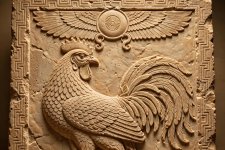 Why don’t we see many sculptures or statues of chickens in ancient Mesopotamia?
One important reason is that the domestic chicken was not a familiar or widespread animal in Mesopotamia for much of the period in which Sumerian, Babylonian, and Assyrian civilizations flourished.
When did chickens arrive?
The chicken originated in South and Southeast Asia. Archaeological evidence indicates that domestic chickens reached the Middle East, including Mesopotamia, relatively late compared with many other domesticated animals. Current research places their arrival in Mesopotamia in the late second millennium BCE, although older scholarship proposed an earlier date, around 2200 BCE. (DOI)
Their arrival was probably connected to long-distance trade networks linking South Asia, the Persian Gulf, and Mesopotamia.
Because chickens were initially unusual in the region, they appear to have been treated differently from animals that were already deeply embedded in Mesopotamian agriculture, diet, religion, and artistic traditions.
What birds were important in Mesopotamia?
This does not mean that birds were absent from Mesopotamian life or art. Quite the opposite.
The rivers, marshes, and wetlands of southern Mesopotamia supported enormous numbers of birds, particularly waterfowl.
Among the birds known to the ancient Mesopotamians were:
* Ducks and geese, which were hunted and, in some cases, raised for food.
* Doves and pigeons, which were associated with food, religious offerings, and the cult of Inanna/Ishtar.
* Partridges and other wild birds, which were hunted and eaten.
* Numerous other water birds and small wild birds.
These birds were much more naturally connected to the Mesopotamian environment and therefore appear more prominently in texts, artifacts, and artistic representations.
What about the famous Banquet Stele of Ashurnasirpal II?
An interesting example comes from the famous Banquet Stele of the Assyrian king Ashurnasirpal II, which commemorates the ten-day celebration held at Kalhu (Nimrud) in 879 BCE after the completion of his palace.
The inscription records 69,574 guests and an extraordinary quantity of food. It lists ducks, geese, other birds, doves, fish, eggs, sheep, cattle, deer, gazelles, bread, beer, wine and many other foods. (Oracc)
Notably, the standard translations of the inscription do not clearly identify domestic chickens among the birds served. This is significant because it gives us a rare glimpse into what was being consumed at a major Assyrian royal banquet.
So where did the chicken come from?
The domestic chicken ultimately originated in Asia, with the earliest unambiguous evidence for domesticated chickens currently coming from Southeast Asia. From there, chickens gradually spread westward through networks of trade and human movement. (DOI)
Older scholarship suggested that chickens may have reached Mesopotamia as early as approximately 2200 BCE, possibly through maritime trade across the Persian Gulf connecting Mesopotamia with the Indus region. (Wiley Online Library)
However, newer archaeological research has challenged the idea that the famous Mesopotamian references to a “bird of Meluhha” necessarily referred to chickens. The identification remains debated. (DOI)
By the Iron Age, however, chickens were clearly becoming established in Mesopotamia and the wider Near East. Archaeological evidence shows increasing numbers of chicken remains and representations from the Late Bronze Age and especially the Iron Age onward. (DOI)
Why don’t we see chickens everywhere in Mesopotamian art?
The answer may be quite simple: chickens arrived relatively late and were not as deeply embedded in Mesopotamian culture as animals such as lions, bulls, sheep, horses, ducks, geese, and doves.
Mesopotamian artists frequently depicted animals that had strong connections to the environment, royal power, mythology, religion, hunting, and everyday life.
The lion, bull, eagle, horse, sheep and various water birds therefore had much greater symbolic and cultural importance.
The chicken simply arrived later.
So when we look at the magnificent reliefs, sculptures, cylinder seals, temples and palaces of ancient Mesopotamia, the absence—or relative scarcity—of chickens is not necessarily mysterious.
It reflects the history of when the bird arrived, how it was used, and how important it became within Mesopotamian culture.
Research and text: Maher Al-Kaji Mimi
If quoting or reproducing this material, please credit the original source.
Image created using artificial intelligence.
The subject was researched using online sources.
Last edited:

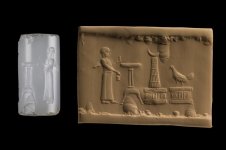
 . Thank you for your reply you gave me keywords to research and find answers. What I discovered is that chickens existed in Sumerian times. There's a lot of evidence about them but unfortunately, there's a significant lack of archaeological discoveries. There are many unexcavated sites in Mesopotamia (Iraq), and this saddens me greatly as an Iraqi. My motivation for research is the existence of a very old Iraqi chicken breed that was raised by local people in the marshes and various cities of Iraq, and I wanted to trace its history.